Monthly Archives: August 2009

Seoul Summary

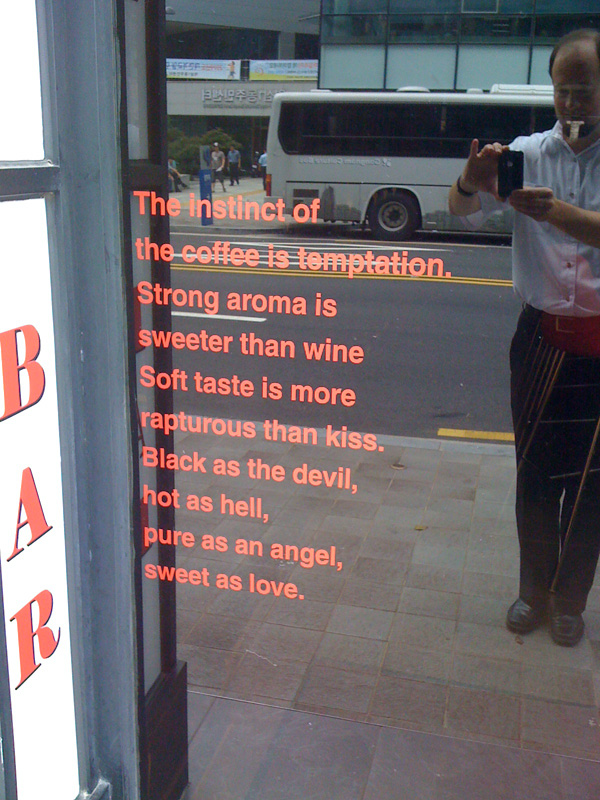
Coffee Temptation
I did not know coffee was that dangerous.  However, standard Korean coffee is like standard US coffee with plenty of milk and sugar and thus bearable, unlike Japan, where it’s black and bitter.  We didn’t eat at this bar, but at a blowfish restaurant, two days in a row.  The second day it was (a) to discuss with a customer in a friendly atmosphere and (b) for those who stayed for rounds two and three the previous night to have a soup.  Note also the wicked cool iPhone I have that has Koreans drooling – apparently, iPhones are not yet available there.  Apple is said to be negotiating some deal, but from what I was told there are two cell phone internet providers that all other cell phones need to use and the iPhone is somehow able to circumvent their monopoly, so it could take a while.  The people can’t wait…
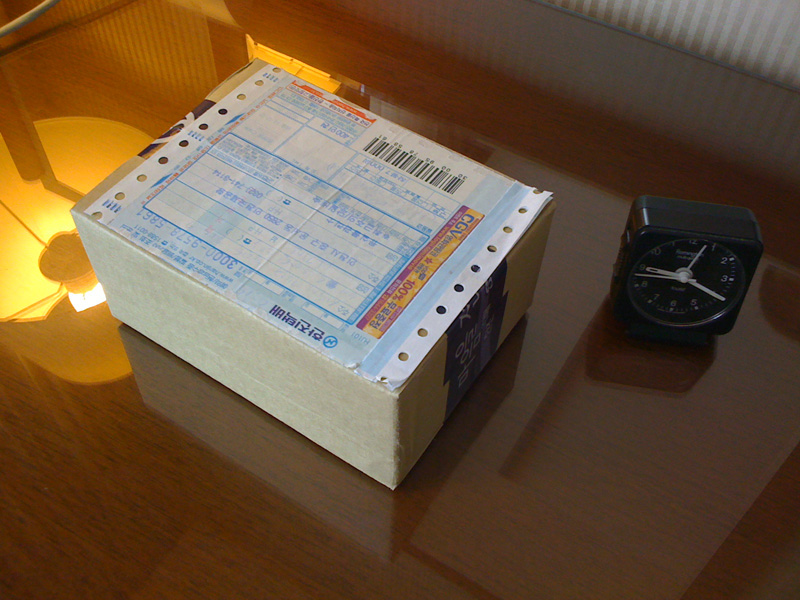
My passport arrives!
Here, for your education, the box in which my passport arrived.  I have to correct my previous information: receiving it cost 7350 won, because the hotel charged a commission fee of 350 won, of which the clerk informed me with so many excuses I began to be embarrassed. 

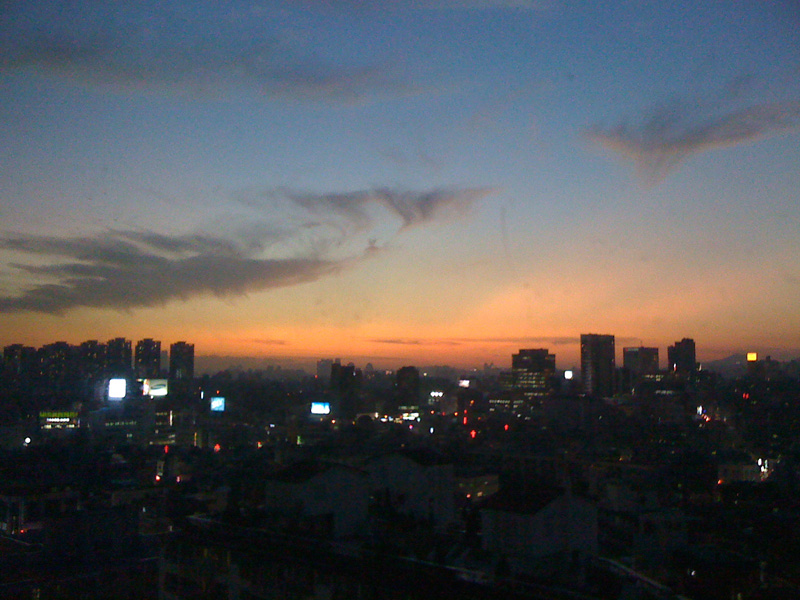
Sunset View of Seoul
This is the view from my hotel room after a day with torrential rain and light hail.  I can also see the Seoul tower, but it’s not on this picture and the iPhone has no zoom I know of, so it only shows up as a little lit stick anyway. 

Pearl Shop in Seoul, Jongno 3ga
Work finished a little early on Wednesday, so I headed here, where I’d already might or might not have been a year ago on August 30.  Most the other jewelry shops had already closed, so I was quite happy to find this one with the lights still on, though later I found out I’d walked up a few minutes past closing time.  The first thing the father said was he remembered me.  A few minutes later and after some conversation that didn’t betray the fact the son suddenly asked, “You’re from Switzerland, right?”  I showed them a photo of Janet wearing last year’s purchase – I keep a few wedding photos on my iPhone – but either they didn’t make the connection or they’re used to their pearls being used for important occasions.  I won’t say what I got this time, but I will make the next photo link to a map of their location.  It’s the best little pearl shop in Seoul as far as I’m concerned. 

Great little pearl shop in Seoul Jongno
Ah, yes, much better with the glasses pushed up. 

And, for closers, a few Engrish shots. 

Yum yum!
Who can resist?  Incidentally, the Japanese “Horumon” doesn’t mean “hormone,” as I long thought, but is a corruption of “horu-mono,” literally “throwaway things.” 

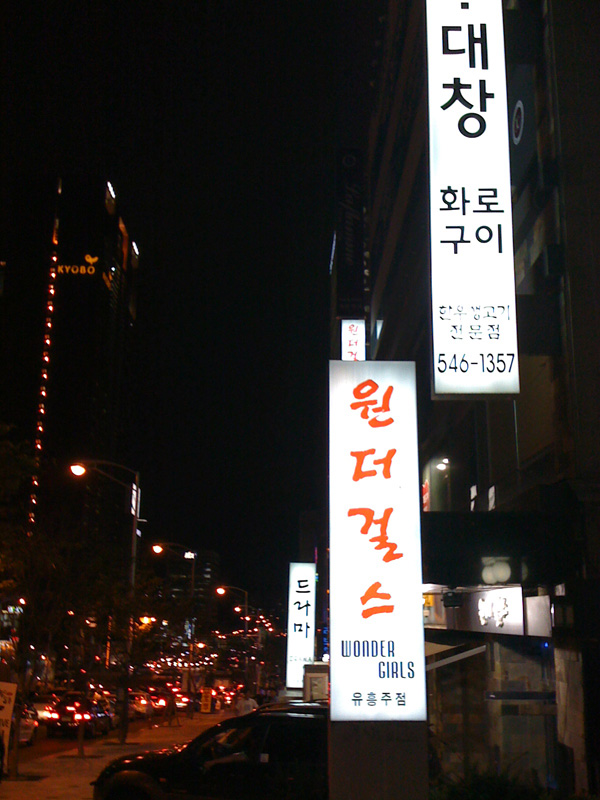
Drama and Wonder Girls! 
It’s too bad you can’t see what you get if you pass the Wonder Girls, but you can always translate 드라마 in Babelfish. 

Empty Gangster
A few words of wisdom from a Seoul Metro traveller…

Sink Instructions
…and some instructions from a public washroom. 

That’s it – time for bed!

Korea’s Atomic Bombs

You’d think I’d know how to travel, having logged over 100’000 flight miles in the last two years each, but after this last flight I feel like I need to go back to basic training.  It started out ok, with me checking one suitcase (containing 7 kilograms of laptop and 4 kilograms of clothing) and getting the baggage slip on the 29 kilograms of microscope, which I took to the customs official to get the Carnet ATA stamped before checking.  But as I walked through the security check (without a beep) and overheard something about “couteau Suisse” I knew I’d forgotten to transfer my toolkit out of my computer backpack and into a suitcase.  I ended up having to transfer my laptop and other necessities into my garment bag and checking my backpack with the toolkit.  (I could have tossed the Swiss army knife, but I wasn’t going to toss the tweezers, which apparently are also dangerous weapons.)  Oh well, worse could happen, I figured – at least now I wasn’t carrying as much. 

Well, worse did happen.  I came to Korea and declared my Carnet ATA suitcase as such; I should have realized that the response of “Oh, Carnet” was to mean a longer wait as the official meticulously went through the forms and tried to figure out what “gemäss Vollmacht” meant.  It was 6:00 am when I arrived and after 6:15 when he was done.  I was happy he at least didn’t ask to open the suitcase and just trusted me on that one. 

I pushed my cart out into the public area, got cash from an ATM, and purchased a ticket for a limousine bus to my hotel.  One of the bus company employees told me where to stand in line.  The next one came, looked at my ticket, and told me to go inside and get a drink because the next bus wouldn’t come until 6:55; I’d just missed the 6:20 bus by four minutes.  A half-hour wait was the last thing I wanted, so I returned the bus ticket and got a cab, which cost seven times as much but at least left immediately. 

At the hotel I opened my bags and took out my travel documents.  My passport was missing, and I realized immediately that it had stayed at customs.  I’d nearly left it there at Japanese customs before, because both they and the Koreans take the passport, put it on their desk with the Carnet papers, and then get so absorbed by the Carnet that they forget to return the passport.  The clerk called the airport for me and gave them my cell phone number, then checked me in with the information I had.  I know my passport number by heart, so I could fill it in the registration form. 

About half an hour later, I got a call on my cell phone.  “Hello,” I said.  “Hello,” said she.  “Hello,” I said.  “Hello, this is Incheon Aipott Lostandpound,” said she.  “Yes,” I said.  “Hello,” said she.  “Yes,” I said – and the iteration continued until she decided to give up.  Why she couldn’t hear me, I did not ever figure out, because after a second try with the same results she called from a different number and it worked.  They’d found my passport and I could pick it up the following day.  I asked if they couldn’t mail it, and they said they could, but I would have to pay for it to the tune of 7’000 Won.  While that sounds exorbitant, it’s only about 6 Swiss francs, so considering that picking it up would mean an hour’s drive each way at the cost of at least four times that I had them send it.  We’ll see if it arrives… 

At 9:00 my partner picked me up.  I’m in Korea to train our partner in the use of our microscopes before they exhibit at the Nano Korea conference next week, which I can’t attend myself.  Teaching the use of microscopes on only a few hours of restless sleep went reasonably well.  Celebrating their recent first sale Korean style – that’s where the “atomic bombs” come in, shots of soju dropped into half-full beer glasses.  Not drinking is impolite in Korea, and after a first one-shot “oltugeja” we ran through most of the individual permutations of drinking to our business and family members.  Someone had the brilliant idea of ordering kaoliang as well, but fortunately I could do my duty with just one shot of the 50%-brew.  Still, by the end of the meal I was full not just from a barrage of “atomic bombs” but also all the food and jasmine tea I downed in an effort to try to minimize the effects of that barrage.  I was driven to the nearby hotel by someone who’d only had a glass or two and immediately conked out. 

Ten hours later, I’m up, and we’ll see what the day brings.  Thirst, for one…

All in a day’s work

Yesterday we had our company outing and before we got to eat dinner we went geocaching.  I’d heard of that before, as one hears of things all the time, thought it cool, and filed it under “Sure, sounds like something I’d enjoy,” which of course means I never did it.  Thanks to Benno (4th post down) I knew it was a global phenomenon, and now the global phenomenon had caught up with me.

Our group grabbed a GPS navigation device for automobiles and my iPhone and headed off to the starting point of the multicache.  A regular geocache is simply a container containing (as containers are wont to do) a logbook and perhaps a doodad, hidden at an often noteworthy location, the coordinates of which are then published on the geocaching website.  When you go on your treasure hunt, you note the coordinates, pack a pen, a doodad, and travel necessities, and follow your GPS device to the location in question, where you hunt for the “treasure.”  In short: you walk to point A and look for the container (“cache”).

A multicache works like a chain of single caches.  In our case, at every location mentioned in the instructions we had to count something or find a number.  Once we had all the numbers, we plugged them into a formula to find the final location of the cache.  We found the container without too much trouble, put in one of those bubble-blowers, and took out a coin.  Once we realized it was a so-called “geocoin,” a coin with a tracking code on it made especially for geocaching, I volunteered to take it with me and drop it off somewhere else later.

Discussing the experience later on with our colleagues, one common sentiment was that it was a great thing to do with kids.  I did another two this evening – the two closest to where I live – and one of them would definitely be fun for kids.  (The other was in an overgrown area without a real path.)  With this in mind, here’s one map of a location that might be familiar to a certain family attending a certain church and could be a fun first geocache for a Sunday afternoon.  Perhaps, to get the kids interested, “geocaching” should be replaced with “treasure hunting…” Here is the map.

On a side note, I’ve noticed that my blog categories need re-working, seeing as I no longer exclusively blog on travels.

How do we treat a sinner?

News about another fallen pastor and his pastoral assistant made me think about how I treat sin and sinners.  I don’t mean people who don’t profess belief in the God of the Bible.  Most of us are quite happy to put those sinners, inasmuch as we have contact with them, into the “lost” or “seeking” box.  The contents of these boxes are rumored to be unaware of sin and uninterested in holiness.  If they ever enter a church, they’re not expected to conform to our rules.

I mean how we treat a fellow Christian who has sinned.  I find it much easier to ignore a sin or ignore the sinner.  When did I last gently rebuke a brother before greater harm was done, or love a repentant brother after that harm was done?  Adultery serves as a good illustration, clearly identifiable as it is.

I am currently happily married and thankful for the lack of real temptation, but I ask myself:
– If someone else asks me uncomfortable questions because he suspects I am getting dangerously close to another woman, will I listen and act?
– Is there even a venue for someone to ask me such questions?  Isn’t the social risk too high a barrier?
– Am I courageous enough to ask similar uncomfortable questions when I suspect something in someone else?

If the answer to all of the above is no, then how can we expect there to be fewer affairs in the church than the national average?

And once the affair happens, there are other questions:
– Do I continue to associate with the adulterer and pour my efforts into restoring him to his wife and the church community through repentance and forgiveness?
– Do we have a process in place for public confession and rehabilitation?

As long as we treat the brother who stumbled as an outcast, as though sin were infectious and not congenital, we can’t be surprised if he who stumbles stumbles even further.  I think a putative lack of Biblical knowledge or doctrinal instruction is but a minor factor here.
A pastor is of course in an even more difficult situation.  His livelihood depends on his position, and his position on his integrity.  To whom can the pastor in safety confess he is staggering, so that his confessor can help keep him from stumbling?  And should he stumble: how can he be reconciled with those whom he has wronged when his sin and economic necessity will most likely force him to leave town?

I think our evangelical churches aren’t set up very well to handle sin, especially sin in a pastor.  The only way I’d choose to be a pastor would be if I wasn’t aware of this structural flaw, or blessed with a supernatural trust in God’s grace and provision, or plain cocksure.

Maybe that’s why preaching scares me.

Swiss National Holiday

Janet often explains that in the US, there is an official separation of church and state, but religion is very much part of national and political discourse, whereas in Switzerland there are three state churches and plenty of religious holidays, but religion is hardly part of public life.  With that background it’s hardly surprising that our national holiday wasn’t made a national day off from work until 1994, but only later in the evening, on our way home from my parents’ house and a good meal together, was I reminded of our national anthem and of how it illustrates Janet’s point as well.  The Swiss anthem speaks of God almost as much as of Switzerland, whereas the US anthem speaks of the flag.  (We discovered this waiting for the train, as we ultimately successfully tried reconstituting our respective anthems – I contributed a critical “o’er” to the Star-Spangled Banner.)  Here are a few links related to the Swiss anthem:

The lyrics of the Swiss national anthem in German and English

A brief history of the Swiss national anthem

You’ll learn that it took twenty years to go from provisional to official national anthem, even though the previous one was likely to make the casual observer think the Brits won the olympic bobsled.