I’ve got two weeks to catch up on in less than two hours, but I’ll try. I now see I’ll fail, so I’ll divide these long posts into sections.Â
February 7: Customer visit in Kobe, preceded by purchasing a train ticket for the next day and trying to pay by credit card, which took at least ten minutes of the poor clerk having to call the authorisation office, consult with a colleague, and work out how to type in some mystic code.Â
February 8: Customer visit in Kanagawa prefecture, after a bullet train ride to Tokyo, where I spotted a Rolls Royce Phantom in the parking garage. Whoever thought that crossing a tin lunchbox with a turtle butt spelled luxury just because it was extra big, was wrong. On the drive home from the customer we saw Mount Fuji silhouetted against the setting sun.Â
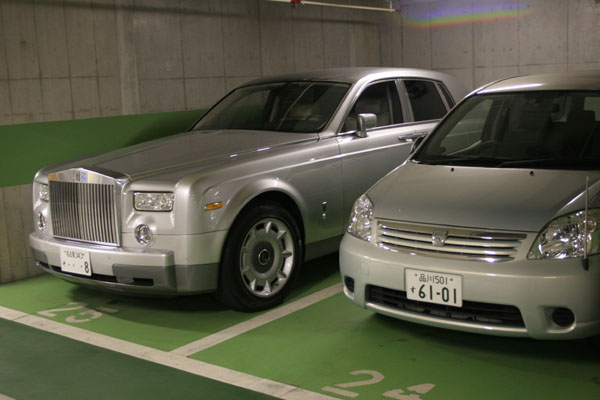
The turtle butt’s a meter behind the little car.Â
February 9: Saturday, so I took the subway to Tokyo Midtown to see if the two drains in one of the indoor pools still drained in the opposite direction. They did, but that was hard to capture on film. I spent a lot of time reading there, just because it’s a well-designed building that makes a person want to stay there. It’s got natural lighting streaming down into its covered courts, sometimes with fountains or water streaming across glass panels. It is easy to navigate and not too big, with all sections looking clearly different and yet part of a whole. It offers plenty of space to sit, rest, and be with friends. Walking through it, looking at it, I couldn’t help but think that this would be a great way to have an urban community (of course, Bertrand Goldberg beat me to that thought by a few decades), though I think it would be too expensive for most people living in apartments and those who could afford such living quarters would probably prefer the picket-fence at equivalent price. But I find the idea of what would almost amount to a village community almost romantically appealing.Â
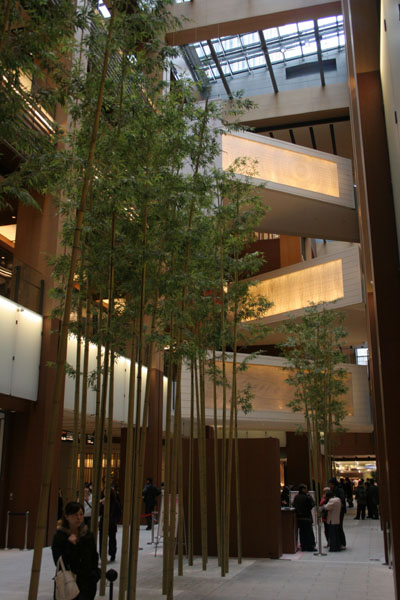
Ground floor view. Of course, this is all shopping space.Â
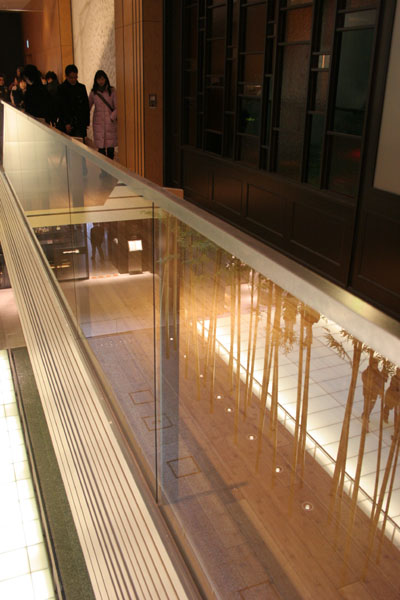
View from the second floor.Â
After hanging out at the Midtown, I headed to Asakusa for my ritual shopping stop, though this time I had only one item to buy: the maneki-neko, which here I finally found. One shop sold nothing but different variations on maneki-neko, though most of them lacked aesthetic appeal or just plain looked cheap. I was also tempted by a couple extra-obese miniature sumo statuettes, but resisted, mostly because I couldn’t think of a suitable recipient.Â
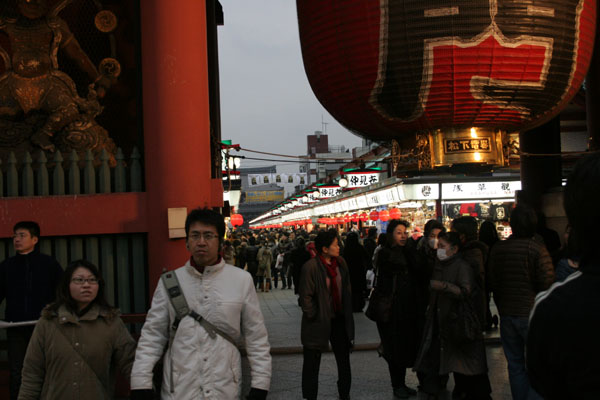
The kaminari gate and the Nakamise shopping street.Â
February 10: I went to church at Honda again. This time, the service was translated, with Sally doing the honors and bravely struggling to simultaneously translate while the preacher went on without pause. Of course, Dan Iverson was preaching, and I understand his Japanese better than that of any of the native Japanese speakers, so this might have been the Sunday when I least needed translation, but I was still glad for it. Before the sermon, the Sunday school kids recited a few verses they’d learned by heart, along with hand motions.Â

Sunday School memory verse recitation. Â
We had a communal lunch, at which I was again told that my Japanese pronounciation is beautiful, which makes me try to change the topic, because I think all it is is my lack of American accent. After lunch I joined the sumodon group of young adults, of whom I must be one of the oldest, for some singing, listening to Megan share how she came to believe in Jesus, and a bilingual game of mafia. After the games we headed to a kaitenzushi place where I ate 9 plates of “sushi” (the egg tart counted as one) for only 945 yen. One of the guys managed 20 plates…Â
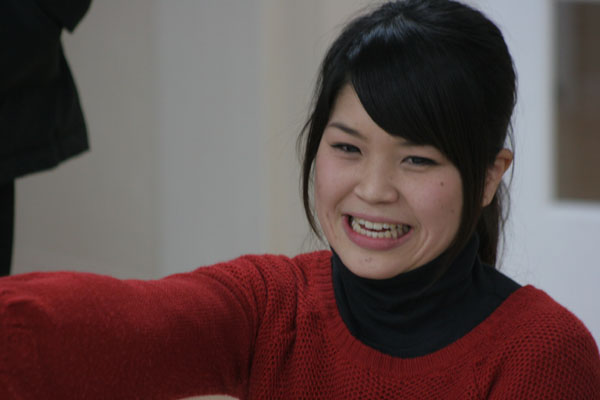
Pointing out the Mafia.
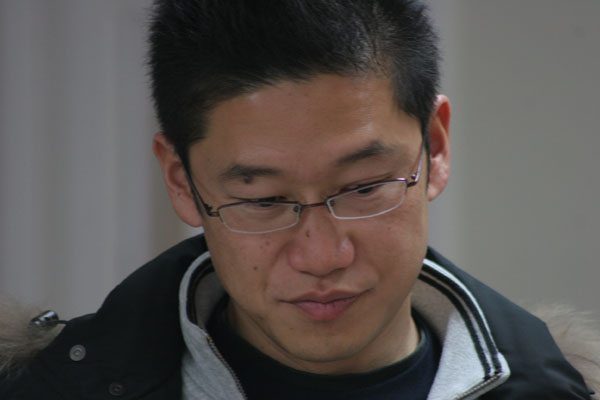
Deep in thought.Â
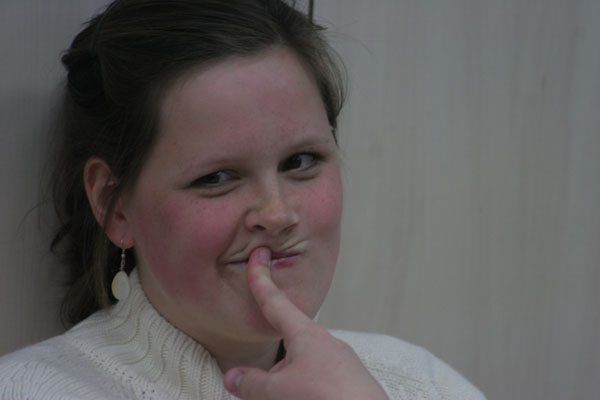
The Mafia.
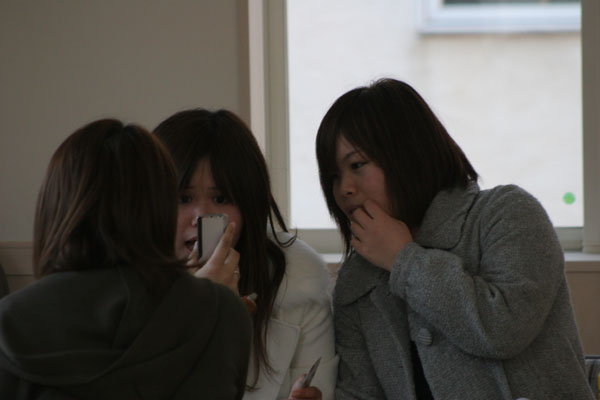
Cell phone surprise.Â
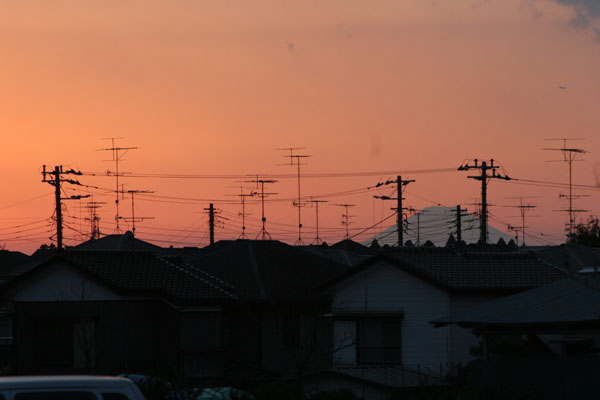
Mount Fuji behind the power lines. The mountain is about 130 kilometers distant.Â
February 11: I headed down to Kanazawa in Kanagawa prefecture (not the Kanazawa where I studied Japanese) to meet up with Olivier Rumley, with whom I’d studied Japanese (in the other Kanazawa), and his family. I’d met Björn for breakfast that day, so speaking French with Olivier meant four languages in two days. There were moments when I felt it and couldn’t think of words in the right language. Etsuko first made us a nabé lunch which we ate while Léon slept. After lunch Etsuko herself took a nap and Olivier and I went for a walk around the neighborhood. Behind their house the hill rises steeply and becomes forested. A short walk through the woods took us to the shrine at the top and a view over residential Kanazawa on the one side and the curious composition of temple, port, and amusement park on the other.Â
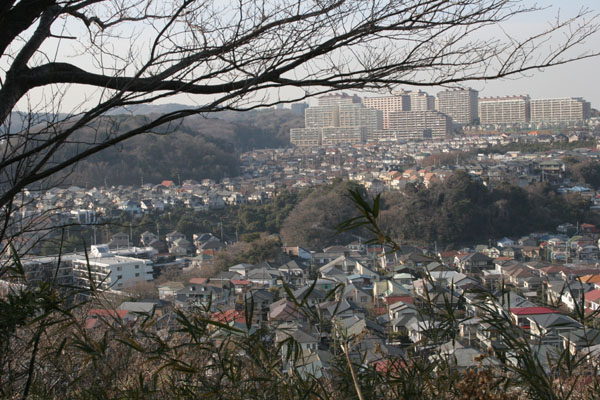
Residential Japan.
We walked down the hill, across a spur, and ended up on the Shomyo temple grounds. A group of men were working on the renovation of the bridge, even though it was a national holiday. I guess constitutions don’t count for Buddhists and businessmen. We saw a few fathers playing ball with their sons on a nearby plot of land and the sunny weather and the day off did bring a number of people out, but not in droves. The temple remained an oasis of quiet, albeit an unsightly one with all the construction.Â
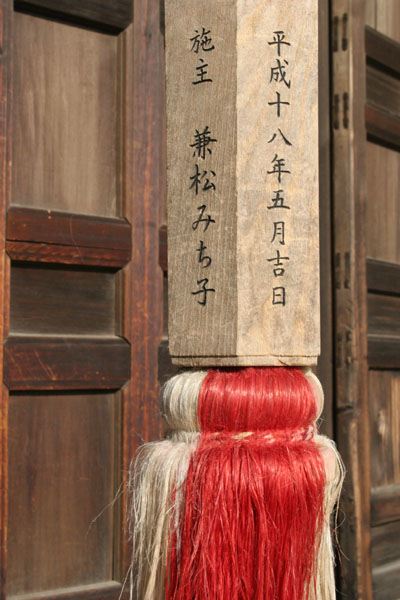
Detail of the Shomyo-ji temple.
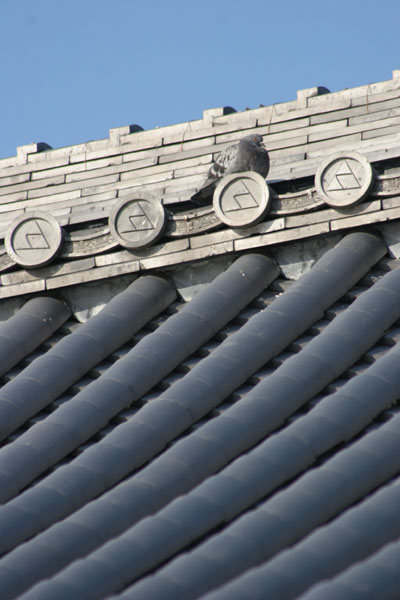
Temple camouflage.Â
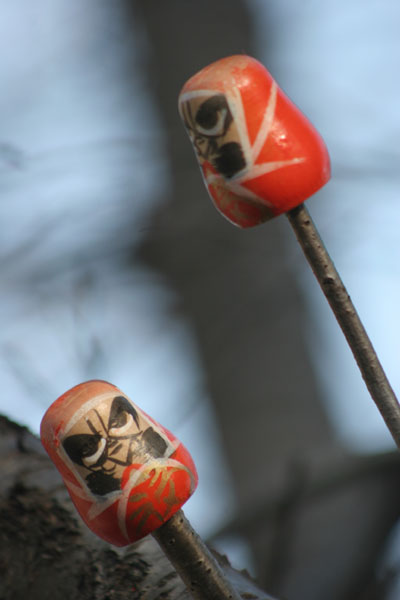
Little mannikins of good fortune.Â
Back home, everyone was awake, and after reading Léon one of his favorite stories we headed out for coffee and cake. After the coffee, I tagged along with the Rumleys to the shopping center, where I was delighted to find Ginga Kogen beer, and the drugstore, where I bought a “dorainoozusupuree” for my next flight. I’ll think of some reward for the first person to figure that one out, which reminds me that the photo challenge a while back remains unsolved. Pikku sent in correct answers for almost all photos, as the only participant so far. The book’s still waiting for you!Â
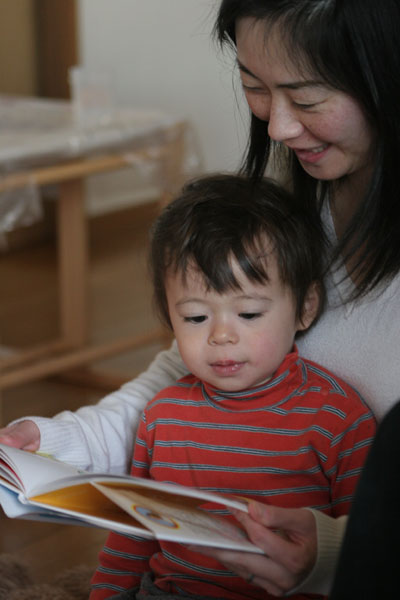
Léon loves the story of the Ouchie that gets thrown around.Â

Léon’s smile betrays his nearly boundless energy.Â
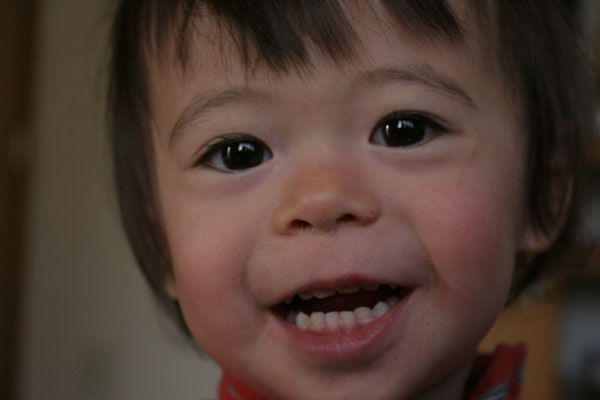
No wonder the Japanese think he’s cute.Â
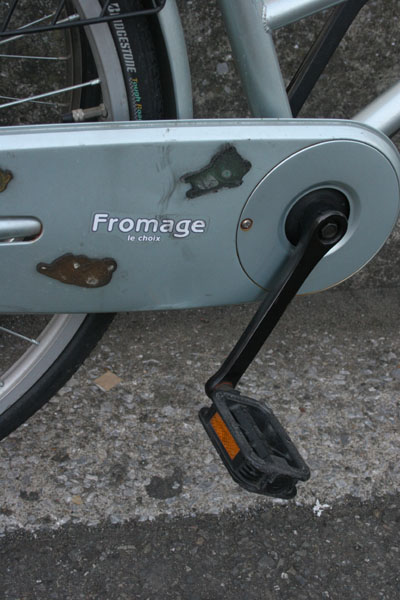
I still stand in puzzlement before this bicycle.Â
When I returned from the Rumleys, I went to a traditional Japanese restaurant for dinner, where I discovered two things: I like Yuzu sour, and fish guts pickled in salt taste just like what you’d expect.Â
Â
What an adorable face!
I’ll let Janet attempt the translation; it sounds to me as if you’re going on some sort of spree with a drain cleaner.
Hmm, that last picture is a little cheesy, don’t you think?
funky riddles, here’s my go at it (in Swiss German so others can keep guessing: “Drochenaaseschpreï”? (E schpreï wo d naase befüechtet?). Do your transcriptions follow some kind of standard? If I guessed it right, it seems that using anglophone phonetic interpretation would get you pretty messed up…
little boy: kawaii!!! (or: söpö)
while it may be a personal choice, the bluish tint of the chain box reminds me of a roquefort with bits of truffles tucked inside…
Was that Olivier’s bicycle, by the way?
Why am I not surprised that pikku wins the riddle, at least in writing? (Unfortunately, Janet won it via previous oral communication.) It is indeed e schprei wo d’naase befüechtet. My transcriptions follow a standard – the only non-standard thing is that I replace the dash which represents the prolongation of the last vowel with the actual vowel. If I didn’t, the present example would read “doraino-susupure-,” which I’m not sure would help anyone.
So, no, nothing to do with a drain cleaner.
Söpö doesn’t really sound like what it means, at least not to me. I suppose it’s all in the intonation.
And it’s not Olivier’s bicycle. I don’t know many foreigners who out of their own free will go for a mama-chari.
Those truffles, by the way, I believe to be bears.
Some rich people do choose to live in the urban community. There is a $500K per unit townhouse structure right in the Oakland section of Pittsburgh. I personally would buy a nice house in the country with a lot of land if I had that kind of money for housing…
I, too, would choose the rural setting if I were spending that kind of money, but million-dollar condos in the heart of downtown seem to be enjoying great popularity these days. I guess it’s good for the city; I’m just glad someone else is willing to do the job.
If I had to live in the city, I can see how a building like that would be better than the standard easy-to-avoid-your-neighbors buildings. But it still looks a little too much like a mall for my taste…I really don’t like malls…I enter, do what I have to, and leave as soon as possible.
(Heather, I hope you find that house in the country with lots of land!)
thanks for the post card, thduggie. we still have a monstrous supply of bushell’s, so I’ll pass on your offer. wouldn’t mind one of those overly fat sumo statues, though… 😉 …no wait, I already have too much useless junk…
I also understand the attractiveness of a house in the country with a lot of land, especially if I worked from home. What I deplore is that often privacy trumps community and those houses in the country become palisaded redoubts instead of centers of hospitality. How many people still sit on their front porches to catch the evening sun and chat with the passersby? How many passersby are there, for that matter, in your average cul-de-sac?
I know that most city apartment buildings are not built for community either, but instead for maximum packing efficiency. That is unfortunate, but if well-designed, an apartment building could foster community, allow for a large common yard for kids to play in; there could be a coffee shop and a hair-dresser looking over the lawn; the plumber and the electrician on the ground floor would face the street; a few restaurants, a bakery, and a butcher could surround a courtyard. I suppose what I’m after is a modern version of the medieaval town with its commons and with people living close to where they work. It seems to me that people lose a sense of community when they live in a place with a lot of people that bear no relation to them. I myself don’t really feel like I belong to my block. I don’t work with anyone who lives there, nor do I buy from or sell to anyone who lives there. It’d be interesting to know if Goldberg’s buildings facilitate community or if the people working there actually commute in from the suburbs and the folks living there drive out to the next WalMart to buy their groceries…