February 12: We set up the booth, which was exciting only because a lot of things came together at the last moment and it took little time to get our stuff ready. Otherwise we mostly spent a lot of time waiting in the cold draft – they only heat the halls when the visitors come. To warm up, the Nanosurf crew went to the Oedo Onsen Monogatari baths two train stops from Tokyo Big Sight. It’s a hot spring that strives to re-create the storybook Edo of bygone days: everyone in yukata, little wooden foodstalls, tatami rooms, indoor and outdoor baths, but with all the modern conveniences. On this cold day, I cared less about authenticity and more about the water temperature. We left a little dazed, but better prepared for a long day.Â
February 13-15: What to say: the nano tech spans 4 halls and draws close to 50’000 visitors over three days. We had planned to run setup demos, where we’d show that an AFM could be set up in less than five minutes. I was the one setting the system up and narrating in English, while one of our Japanese partners translated. This worked quite well the first day, but it became clear that we needed a mike, which Björn organized for Thursday. We only did two or three demos that first day, which is why I had time to take a few pictures.Â

Our booth.

I had to fill out a questionnaire to take this picture. On Thursday I popped briefly into the HVAC&R exhibition to visit Dad’s former business acquaintances at PS Group and noted a change to shorter skirts and colors that seemed straight out of sci-fi comics on the Hisaka Works booth (silver boots! bright pink skirts!). If you look closely, you can tell this one here works for Toshiba. The ensuing conversation brought out that she’s “kuootaa.” One of her grandparents is American.Â

Closing time. Once we came to the line at the train ticket machine, we decided to eat near the exhibition site and wait out the crowd.Â

All three exhibition days the sun shone bright, at least in the morning, and the air was clear enough to see Mount Fuji from the Yurikamome line. Of course, we spent our time under artificial lighting, only to emerge after sundown. Thursday we got our mike, and started running the show every hour, with a bit of a break at lunchtime.Â

This was our biggest crowd. Starting was always hardest: I’d shout “If you want to see a suitcase turned into an AFM in under five minutes, here’s your chance!” which usually got translated as “Soon, the set-up of an AFM out of a suitcase will occur here.” People passing by would look at me and take evasive action, but as soon as things got moving a bit and one or two people stopped to look, everyone stopped to look. It was fun trying to come up with new lines and turning passersby into sales leads, and I often had to smile at how the translations got toned down. My “easy to set up, easy to use, and easy to buy!” (inspired by Björn) got turned into “easy to set up, easy to use, and of economically advantageous nature” or something similar.Â

My main point in posting this picture is to show the extent of the hall. If you started at the back wall you see, you’d get to our booth about 60% down the way. This photo also shows the Nespresso coffee machine we had, which makes just under two coffees in the time it takes to set up the AFM (with the computer already running). With no tea makers on our booth, I relented and had a couple coffees (two sugars, 50% milk). In general, I drank far too little, especially on Friday, when we decided to step up the demos to every half hours.Â
On Thursday evening, our Japanese partners took us out to a shabu-shabu restaurant near Shimbashi station, in a building full of game halls and massage salons manned by Chinese women. Our waitresses were also Chinese, and I was proud to have recognized that by their accent. Our partners had told me that my idea of walking a bit farther to get on the train a station before everyone else was a very Japanese ploy – but I think that’s the extent of my thinking like a Japanese, unfortunately.Â
Friday the show ended an hour earlier to give us more time to pack up. I had a motivation to leave as soon as possible because I wanted to meet up with Dean, one of my classmates from my Japanese class from last July, to go hear Quadra at the Rooster jazz club. I prepared as much as possible Friday morning and also had made the packing invoice ready, and both Björn and Ola started shutting systems down a bit early and prepping everything, so once take-down began it took us about 45 minutes to pack everything up. The only thing I forgot were the keys to the meeting room and store room – same forgetfulness as last year!Â
I made good time out to Ogikubo and met Dean at the station. Last year, I got to see Kazuhiro Takeda play in the Dodekachordon formation; this time, it was back to the formation I’d originally heard – my third Quadra concert by now – and this time they were joined by another saxophone quartet, Saxophobia (perhaps named after Rudy Wiedoeft’s tune?).Â

Quadra in performance in front of a sell-out crowd. It was only thanks to Mr. Takeda that we even got seats.Â

Eight saxophones on stage. I remember my first shawm concert when they let loose just because of the sheer sound volume. I don’t remember what they played at the end of the first set when they joined forces, but for the second they played what I had thought all along they should play, Joe Zawinul’s “Mercy, mercy, mercy.” Now all they need to do for the next show is come up with an arrangement for eight saxophones of “Everybody needs somebody to love” from the Blues Brothers movie…Â
Both Dean and I agreed we preferred Quadra, though I don’t think either band saw it as a contest. Quadra plays with more edge, groove, and tempo, whereas Saxophobia plays a more mellow sound, sometimes incorporating flutes and traditional Japanese woodwinds. It was late by the time I got home, but I was glad I’d gotten to hear these guys again, and experience the atmosphere of a small club crammed with enthusiasts.Â
February 16: I met up at 7:30 at Shimbashi station with Chiharu, whom Cornelia knows from her time in Vancouver and travels in Kenya after Sophy’s wedding, and we took the subway to the Tsukiji market. It opens much earlier than we arrived and apparently hosts a daily fish auction. As a result of long-term promotion, tourists these days are too plentiful and restricted from entering some areas, though we either didn’t approach those areas or just simply didn’t notice.Â

The typical transportation cart, which I’d never seen before. Quick to mount, easy to steer, stripped to the bare essentials.Â

Some of the produce.Â

Veggies, as far as the eye can see.Â

He said he was embarrassed, but taking a picture was okay, as long as I didn’t sell it. He said nothing about posting it on my blog.Â

The fish is frozen, then processed with a band saw.Â

Before the sawing process.Â
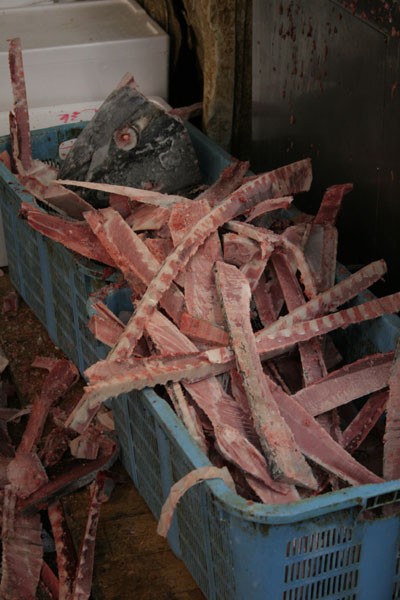
Scraps left over after sawing.Â

Pre-cutting fish blocks for sashimi.Â

Sea cucumbers, namako in Japanese. I have no idea where they end up, but I bet they’d make a fun prank assault weapon.Â

One of the prettier seafood stalls. The grossest had to be the whalemeat stall, with dark red chunks of meat oozing blood onto the colorless, transparent plastic sheet beneath.Â

Shellfish.Â

Weird shellfish.Â

Octopus ikebana.Â

Fish.Â
We headed north to Utsunomiya from Tokyo, after a short coffee-and-donut breakfast, where we met up with Tomo and Eunsook for lunch. Tomo I’d never met, but kept in touch with irregularly via e-mail after having been introduced by possibly Sophie – neither Tomo nor I remember, but it had something to do with the Navigators. Eunsook had just moved to Utsunomiya from Basel a few months ago for her job, and had to learn how to drive because she was going to be unable to commute by public transport. (Eunsook says hi to all the BCF folks.) Because Utsunomiya is known for its gyoza, we ignored the current Chinese gyoza scare and filled up at a gyoza place near the train station.Â

Yaki-gyoza – also know as potstickers or Chinese dumplings. (That recalls a vague memory of a kids’ story where dumplings keep growing and growing until they overflow from the pot and fill the house – made all the more mysterious because at the time I had no idea of what dumplings were.)Â

A much too dark picture of Chiharu, Tomo, myself, and Eunsook, that I had to lighten up to grainy poster quality just so our faces would be visible.Â
After saying goodbye to Tomo and Eunsook, who both had plans that afternoon, Chiharu and I headed out to Nikko. We both slept on the train, and she had to wake me up when we’d arrived. From the town of Nikko we took a bus up to Chuzenji lake, where we got off and, bracing ourselves against the frigid wind, walked to the Kegon waterfall. We didn’t stay long, due to the merciless wind that whipped through our clothes and needle-pricked our faces, but walked to the lake to see it before the sun set. If anything, the wind was stronger coming off the lake, and as soon as the sun had set we set out to find the Chuzenji onsen. It felt great to soak in hot water, but the bus departure time limited me to just about five minutes, because I’d wasted a lot of time trying to get my coin locker to work.Â

Kegon Falls.

Lake Chuzenji.
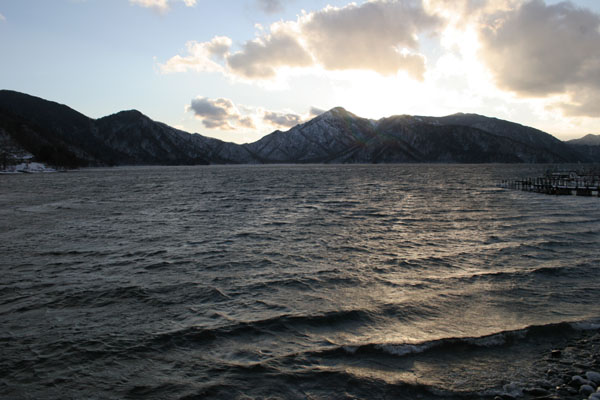
Lake Chuzenji.Â
It took a long time to get back to Tokyo, but we did, sleeping most the way.Â
February 17: I went to Honda chapel again, but this time left pretty soon after the service, because there were a few things I needed to do in Tokyo, though I ended up forgetting to purchase toe socks. I wasn’t done sleeping in trains, and I have yet to learn how to get up on time to get off. Fortunately for me, Tokyo main station was the final stop, so other than getting to experience the odd feeling of waking up in an empty train car, no harm befell me. I was under some time pressure to make it back to the hotel on time to skype Switzerland, but although I expressed it poorly at the time, that’s the kind of pressure I don’t mind.Â
February 18: I just barely made the Narita Express from Tokyo, having gotten off to a late start from Shiodome and having underestimated the time it took to lug two suitcases to the train station, but got to relax on the train and then, after check-in, in the lounge. The only surprise for me was that I wasn’t able to check my baggage through to Melbourne: I would have to pick it up in Shanghai and then check it in again. In retrospect, I should have simply taken all luggage through the nothing to declare line and checked in without any regard to my Carnet A.T.A, but I thought I’d play it by the book, or at least by what I thought the book asked of me, which would be to get a transit paper stamped. This confused the customs employee, who had just arrived, and after I had told her I didn’t want to have the importation form stamped she said “wait a moment” and went into her office and ate dinner. I paced outside, waiting for a sign of activity that didn’t involve mastication. Just as I was about to take off again a guy appeared who had a better command of the English language. Things were happening. After a few discussions back and forth he suggested I just ignore the whole Carnet thing and go through customs without a stamp, which I would at that point have loved to do, but I’d already filled out the blue transit form, thinking that was the right thing to do. It turned out the customs official had never come across the blue transit form, which including me made two clueless people on either side of the transaction. They took the form I’d filled out, stamped the thing somehow, and told me to explain the incident to their Australian colleagues. While the incident proved to me that I still need a good helping of patience, it may have proved beneficial in the end, because I ended up being upgraded to business class, further corroborating my suspicion that tardiness at check-in gets rewarded by a better seat. With the business class seat I managed to sleep pretty well, waking up just in time for breakfast – the smell always wakes me up despite eye covers and earplugs.Â
February 19: Melbourne customs handled the Carnet well. Janelle, the girl handling my case, had just started her shift and I think had never done a Carnet, but she had a number of experienced colleagues to walk her through the procedure. I asked about the transit sheet, where I thought I was missing a stamp, and the Australian guy said that as long as I got home with all the stuff on the list, it didn’t matter which stamps I did or didn’t have. That said, Melbourne airport does not handle customs well. It takes at least an hour to get through, and that was only because I was in the shorter “difficult” lane because of my Carnet. I don’t know if the length of the line correlates with the presence of the filming crews, or if it’s always that long and only coincidence that both times I’ve arrived internationally at Melbourne Tullamarine filming crews have been present. They generally slouch with their equipment on chairs near the customs exit, looking bored, waiting for the opportunity to shove a microphone into the face of some poor long-distance traveller who ideally struggles with English.Â
Steven picked me up and drove me to the hotel. For the next three days, Steven would be my driver and accompany me on customer visits, usually to universities in the middle of orientation week. We had a good few visits that allowed him to get a first handle on our microscopes.Â
February 22: In the evening I took a train from Southern Cross station to Glen Ferrie, where Tim works, and met him at his office. We picked up his daughters from childcare and drove to their home, picking up two pizzas on the way for their traditional weekend kick-off food (which is usually home-made, but not this time, due to Tim’s travels). Viv was out with friends, so I didn’t get to see her until late, and then only for a few minutes, as it was time to get back to the hotel. I have no pictures of the girls on the backyard trampoline, but here are a few pictures that are right up there with Léon’s on the kawaii scale.Â

Izzie loves pizza!Â

Caitlin is a bit more successful in keeping it out of her hair.Â

Tim and the girls.Â

Isobel playing with what I think is a bathing suit.Â
That’s it for now – I’m still a week behind, but it’s 12:30 and well past bedtime.Â
Â


