A useless ranking of the countries of the world

Rank the countries of the world by how many different airports you’ve visited in it (not counting picking someone up).  You must at least have left the plane (that’s why Nairobi doesn’t count for me).

I’ve probably forgotten some, but for me, the current ranking looks like this:

USA 17 (Atlanta, Baltimore-Washington International, Charleston S.C., Chicago, Dallas-Ft. Worth, Denver, Los Angeles, Medford International, Minneapolis-St. Paul, New York JFK, Orlando, Philadelphia, San Diego, San Francisco, Savannah, Seattle-Tacoma, Washington Dulles)

Japan 8 (Narita, Haneda, Sendai, Sapporo, Komatsu, Chubu, Kansai, Fukuoka)

Tanzania 4 (Arusha, Dar es Salaam, Zanzibar, some airstrip out in the savannah)

Spain 3 (Barcelona, Bilbao, Madrid)

Germany 3 (Frankfurt, München, Düsseldorf)

China 3 (Beijing, Sanya, Shanghai)

Australia 3 (Brisbane, Melbourne, Sydney)

South Korea 3 (Gimpo, Incheon, Jeju)

UK 3 (London Heathrow, London Luton, Manchester)

Finland 2 (Helsinki, Ivalo)

New Zealand 2 (Auckland, Rotorua)

France 2 (Paris-CDG, Paris-Orly) (and Mulhouse, if you like)

Switzerland 2 (Basel, Zürich)

Singapore 1 (Singapore)

Malaysia 1 (Kuala Lumpur)

Thailand 1 (Bangkok)

The Netherlands 1 (Amsterdam)

Ireland 1 (Dublin)

Austria 1 (Vienna)

Czech Republic 1 (Prague)

Turkey 1 (Istanbul)

Saudi Arabia 1 (Riyadh)

Syria 1 (Damascus)

Morocco 1 (Marrakech)

Portugal 1 (Lisbon)

Canada 1 (Winnipeg)

United Arab Emirates 1 (Dubai)

All others ranked jointly last.
Everybody’s Normal… Part I

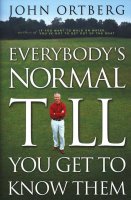
NormalI recently finished John Ortberg’s “Everybody’s Normal Till You Get to Know Them,” which I had already referred to in my brief review of Ortberg’s equally phrasally titled “If You Want to Walk on Water, You’ve Got to Get Out of the Boat.”  The link on the “Normal” title takes you to Sursumcorda’s review, which mentions the aspects of the book I dislike (and which seem to be endemic to Ortberg’s writing).  The one habit of his I most regret is his propensity to interrupt serious material with a cheap laugh, which instantly undercuts his argument.  In many cases I end up remembering the dumb joke and not his point.

Nevertheless, in what follows I will try to summarize and comment what stood out to me in Ortberg’s book, passing over the distracting asides and loose writing which plague the book.

The first important point to make is what Ortberg means with “normal.”  He never defines it, but from what he says it is clear “normal” for him is the state humans were created for, i.e. the sinless state before the Fall.  This took me by surprise, because I think that sin is normal for the human condition on this earth, but Ortberg is right in saying that in meeting a person we tend to expect sinlessness, not depravity.  So for the duration of the review, I’ll use Ortberg’s definition.  That said, Ortberg seems to implicitly agree that sin is normal (i.e. usual) when he says about our approach to others: “We enter an endless attempt to fix them, control them, or pretend that they are what they’re not.”  To a degree, I think this pretense is healthy and what is necessary to give the other the benefit of the doubt.  But if we don’t keep in mind that the beneficiary of our doubt may not deserve it, when the pieces all come together and we realize that the explanations for poor behavior were just illusions we will not only have to deal with a person who behaves poorly but with our own selfish indignation at how we gave the benefit of the doubt for naught.

Ortberg quotes Dallas Willard as saying that assault and withdrawal are the two essential forms of relational sin.  “We assault others when we act against what is good for them.  (…)  We withdraw from someone when we regard their well-being as a matter of indifference to us.”  If that is true, relationships require wise and perceptive judgment and a great ability to imagine the other’s situation.  I have to judge what is good for a given person, even if it’s the opposite of what they demand, and act on my judgment.  I have to judge, due to my own limitations (because caring requires work and time), with whom to engage, so as not to serially withdraw from people.  And, given my own limitations, I have to be quick to call my judgment into question and revise it.

Further on, Ortberg says: “In community – the divine community especially – a heart comes alive.  To experience community is to know the joy of belonging, the delight at being known and loved, the opportunity for giving and growing, the safety of finding a true home.”  It requires the courage to be vulnerable and the courage to be gentle with a vulnerable person.  Refusing to be vulnerable or abusing vulnerability raises barriers and creates disunity.  According to Ortberg, “[t]o allow or contribute to disunity in [the body of Christ] is to be fundamentally at odds with the purpose of God in human history.”  (That does raise the question of whether the concern for unity can trump doctrinal or pastoral concerns.  I have my doubts, but certainly unity is at the core of what the body of Christ ought to be.)

Ortberg quotes Alan McGinnis’s #1 rule for entering into deep friendships: “Assign top priority to your relationships.”  That’s a good reminder, because at least for me many other things vie for top spot and have a way of sneaking into priorities they don’t deserve.  Computer vs. Joseph should always be a no-brainer, no matter what I’m doing on the computer.  But it isn’t.

Another good reminder: “If you want a deep friendship, you can’t always be the strong one.  You will sometimes have to let somebody else [do for you what you can’t do on your own.]”  I think that’s particularly tough for guys.  We’re often raised to be strong, to be the leaders, the heads of households who decide with firmness and have things under control.  We need to shed some of that baggage and both realize and live as though we can’t do everything on our own.  It’s why we believe in Jesus as our Lord and Savior.  It’s why we married a wife with qualities we admire.

Ortberg tells a story of a pastor who struggled on his own with a tough problem, until he realized he needed help.  But even then he was far more comfortable helping the others in his group, and took a long time to come out and share his own struggles and failures.  Contrary to his expectation, the others didn’t show condemnation, but compassion.  In other words, I can’t taste grace without admitting my sin.

A statement that should inform the wise and perceptive judgment I mentioned above: “Just as love is the ultimate expression of the law, so lovelessness is the ultimate expression of sin.”  Our judgments about relationships and others need to be suffused with love.

Because I made it to the end of Part I of the book in this summary, I’ll publish the post now and promise parts II and III in later posts.

Finally, more videos

Here’s a spate of videos from early 2012.


Joseph reads letters.


Joseph admires Grossvater’s Duplo tower.


Joseph says it as it is, with learnèd commentary from the grownups.


And it wasn’t even intentional.


Joseph playing with his Christmas present.


Joseph likes to help with laundry. And he misses Dad-o.


Not too sure what to make of all the changes.


But he loves to “kikh” her.


More evidence.


Joseph loves the Noon reading from the Book of Common Prayer. We’ll try to get another video where more of his face is visible.


Joseph and the US States.


Joseph loves anything with letters…


…and his new chalkboard, a gift “from Vivienne.”


And the US States again, showing them to Dad-o.


Joseph’s counting square.


Joseph counting. It’s fun watching these videos because even now he’s already changed and they feel nostalgic.


What he means with his “a doh, a dee” we don’t know.


He knows the way of the modern world: quick soundbites and done.


The gift is from my co-workers for Vivienne, but right now Joseph is the one to enjoy it.


Joseph’s attempt at “Fleisch” sounds a little fishy in German.


He usually gets tired after lunch, but rarely this tired. He just barely manages to sign his desire to play.


One example of Joseph’s expanding communication skills.


Joseph plays Great Gobble Gobble with Mommy.


Joseph helps Mommy massage Vivienne.


Joseph rocks back and forth on the wagon for the building blocks. I keep expecting the wagon to break.


Just to prove he can say more complex sentences in both languages – IF you can parse them. Dad-o should watch until the end.

I hope you enjoy them, even if there are a-plenty.

Book giveaway page

I’ve decided to post books we want to give away on a separate book giveaway page that I’ll be updating regularly as we empty our bookshelves.  These books will go into plastic boxes in the cellar, and then, if they remain unclaimed, given away to the local used book store.

There are currently 30 books there, some already claimed.

More photos – of more people

There are new photos up in the usual place, and they include our fourth family member, Vivienne Linda.  After the winner of our son’s baby pool was the paternal uncle, the winner of our daughter’s baby pool is the maternal aunt.  Depending on how you extrapolate that, we can’t have any more kids…  Anyway, congratulations, and the prize is purchased (for both!) and will soon be on its way.

Birth data is included in the photo captions!  Those who don’t know the login and password, just ask me.

7 Quick Takes VIII

— 1 —

Another Dots in Books update: My first sale! I sold a copy of the mid-length version of my counting book for kids to the Kantonsbibliothek Baselland, where I will have to stop by one of these days to check on how it’s doing. Next step: write a bunch of libraries.

Counting book for children

— 2 —

The White House has also published something: their 2011 Christmas card. It seems people are upset about it because there’s no tree in it and that’s not christmasey enough.

— 3 —

Santa Automaton by Dug North
So I’m adding some christmasey artwork just in case.

— 4 —

But finally, it’s not christmasey looks but christmasey deeds that make a Christmas christmasey. I’m sure that’s how the KMart customers felt whose layaway bill was paid for by anonymous donors.

— 5 —

But if you want to make sure your Christmas is christmasey enough, leave it to the standards bureaus. Their standard-bearer this season is the Dutch office with their NEN 0512 Guidelines for Sint-Nicolaas Festivities.

— 6 —

Just make sure you comfort those kids who ran into Zwarte Piet, because new research seems to show that letting very young children cry uncomforted is bad for them.

— 7 —

And instead of writing a seventh take, I’ll take time for Christmas, and later time to listen to the seven takes before and after mine.

For more Quick Takes, visit Conversion Diary!

7 Quick Takes 7


lazy video version

— 1 —

Here’s to pollination, in all its forms, and to beautiful nature camerawork:

Judging by the end, it’s from yet another TED talk.

— 2 —

And here’s to the power of sight restored:

The Christoffel Blindenmission ran this call for donations, which I enjoy because of the emphasis on the outcome, not the pitiable current state.

— 3 —

Finally, here’s to the power of words well-deployed (not entirely safe for grandkids):

There are four episodes of this yeoman warder guiding entertaining visitors to the Tower of London.

— 4 —

And because we’re lazy, here’s to the power of cool tools. The Wacom Inkling lets you sketch on paper and transfer the drawing to your computer as a vector graphic!

If I did serious any sketching, this would be high on my wish list.

— 5 —

Speaking of power, the largest Swiss railroad company, the SBB, uses mostly electric power to move its trains. They used a total energy of 2.4 GWh in 2009. Google uses electric power to run its servers. They used a total energy of 2.3 GWh in 2010. They both say they make the planet greener by using loads of energy.

— 6 —

And if you want to gain extra power, here’s the new sports drink fad: pickle juice.

— 7 —

Finally, I knew of the (limited) power of positive thinking as evidenced by the placebo effect, but had no idea of the power of negative thinking as evidenced by the nocebo effect. An extreme example of how strong this effect can be is the story of a 26-year-old participant in a clinical trial of antidepressants who tried to overdose on his pills, eating a month’s worth. He “experienced hypotension requiring intravenous fluids to maintain an adequate blood pressure” until someone found out and told him that he’d overdosed on placebos.

What do we learn from that? First, attempting suicide with stuff from a clinical trial is stupid. Second, let your spouse read about the possible side effects of the medicine you’re taking, or you may fall sick from the knowledge of the possibilities alone. Third, this is why Advent should be a time of quiet fasting, not stressful shopping, so that we’re actually healthy come Christmas!

For more Quick Takes, visit Conversion Diary!